RETICASH · Financial Technology Ecosystem

A financial
technology ecosystem.

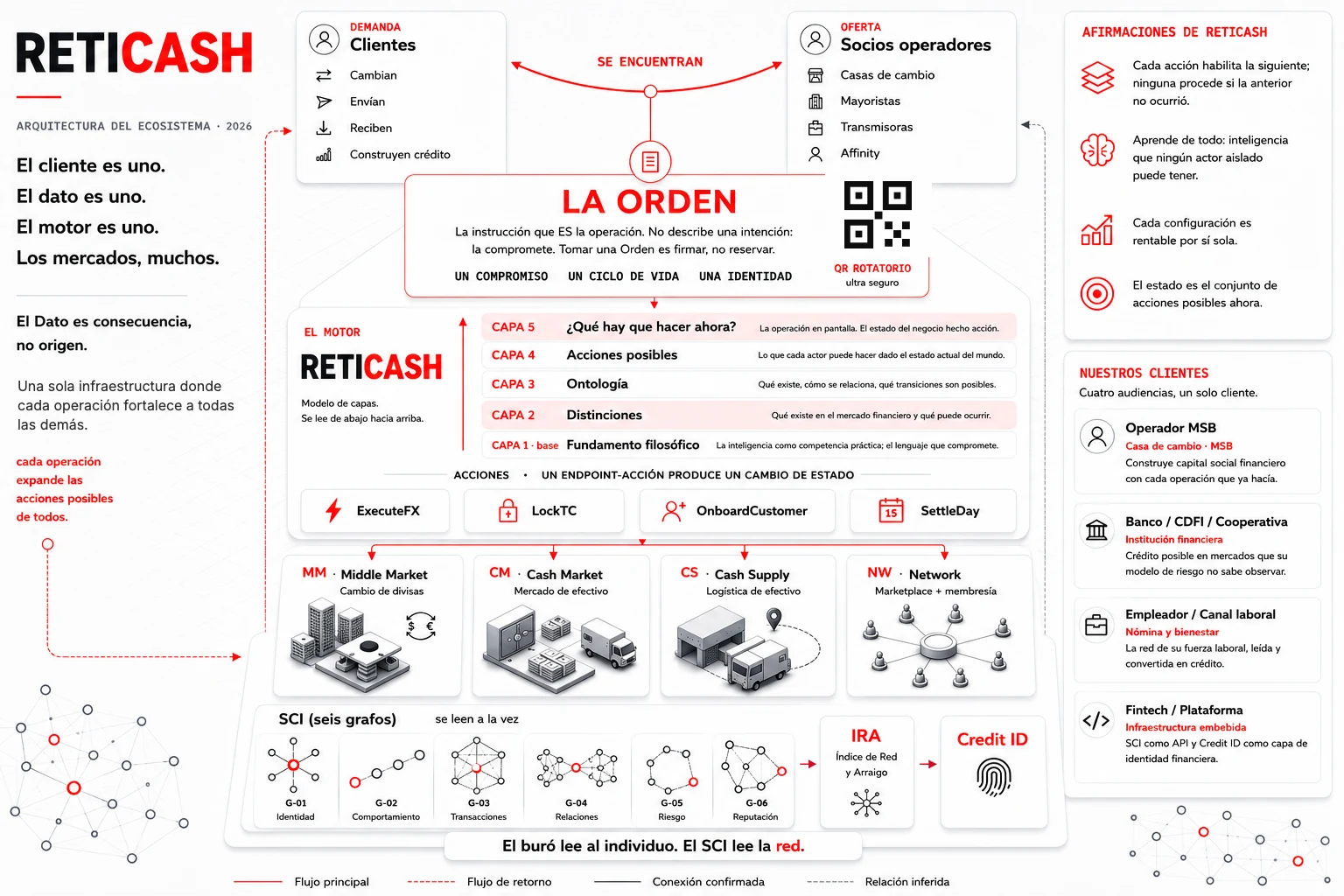
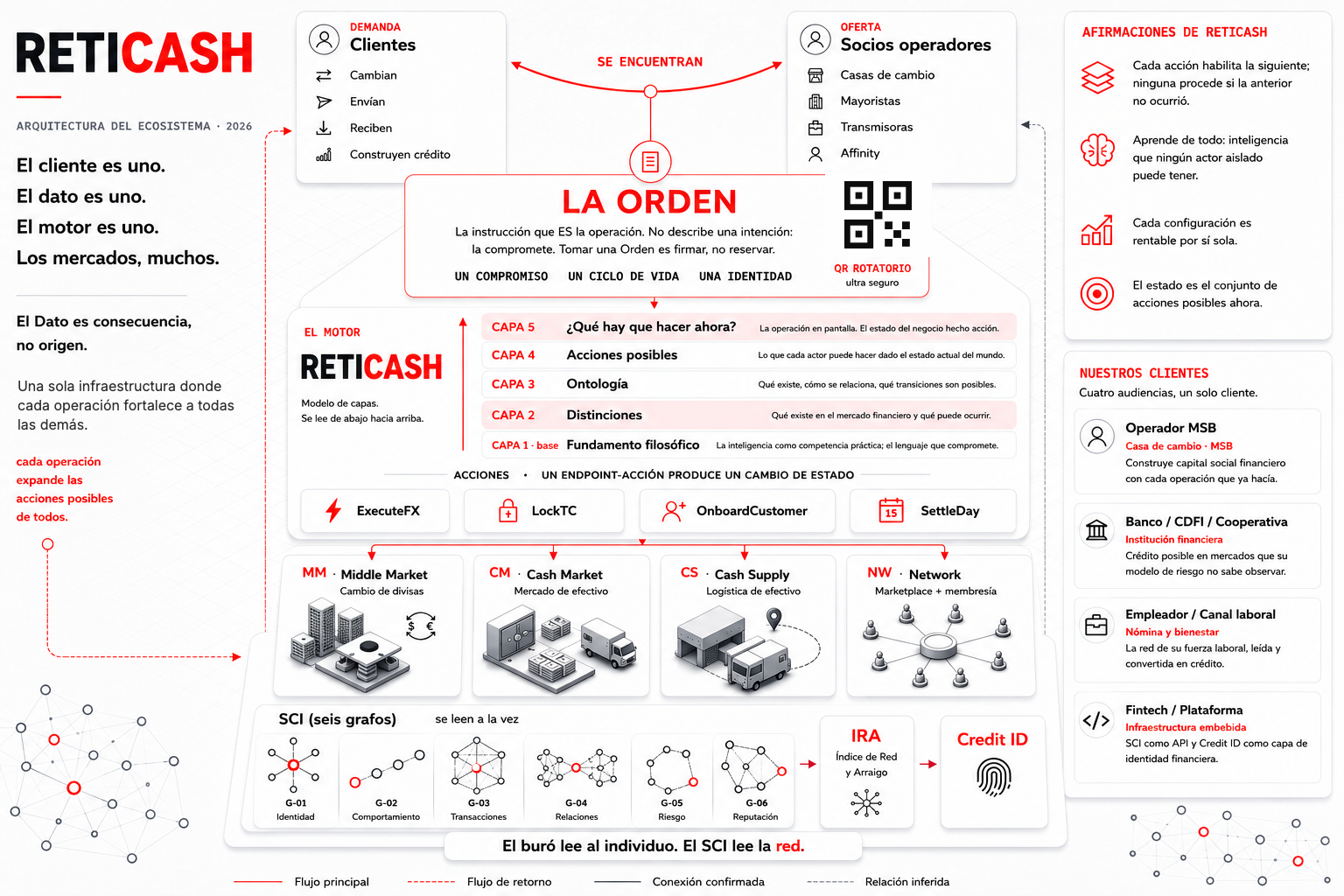
A single infrastructure in which every operation (exchanging, moving cash, remitting, extending credit) strengthens all the others. One client. One ledger of behavior. One engine. Many markets.

The architecture of the ecosystem
Demand
Clients
ExchangeRemitReceiveBuild credit
they meet
Supply
Operating partners
Exchange housesWholesalersMoney transmittersAffinity
The central object
The Order
The instruction that is the operation. It does not describe an intention: it commits it. Exchange, move cash, send, extend credit: in all four, what is issued and executed is an Order.
It travels in a rotating QR, ultra secure.
The engine
RETICASH
One shared architecture in five layers: Philosophical foundation → Distinctions → Ontology → Possible actions → What must be done now? Data is a consequence, not an origin. See the architecture →
MM
Middle Market
Currency exchange
CM
Cash Market
Cash marketplace
CS
Cash Supply
Cash logistics
NW
Network
Marketplace + membership
The brain · it learns from everything
SCI · Credit ID
every operation feeds it, and it informs every market

Every transaction makes the ecosystem more valuable.Each configuration stands on its own. Together they yield an intelligence no single actor could hold alone.

Product

Three systems.
One architecture.

RETICASH

An operating platform for the financial market. Exchange, transfers, and B2B operations. Three surfaces. One system of action.

Exchange

Rate-lock and membership rates are cases of the Order in Middle Market; inventory is reserved per window. The SCI accrues in the background from the very first operation.

Remittance

Cross-border movement of value with continuous financial identity. Credit ID grows at origin and destination at once.

B2B

Working capital and corporate FX, with Credit ID for legal entities.

Membership

A standing in the system that unlocks a set of actions that without it would not exist. Access to preferential rates across the marketplace.

Configurations
Network

Marketplace + membership · exchange with a pricing club.

network.reticash.com
Middle Market

Currency exchange.

mm.reticash.com
Cash Market

Cash marketplace.

cm.reticash.com
Cash Supply

On-demand cash logistics.

The Order
The common atom of the four configurations.
Issued · accepted · fulfilled · settled
Exchange, move cash, supply inventory, extend credit: in all four, what is issued and executed is an Order. A commitment with a lifecycle running on the same infrastructure. The market changes; the Order stays the same.
The product, live
System · The network
Client app · live

SCI · Social Capital Index

The architecture that renders legible a market traditional systems have no way to observe. Six graphs read at once.

G-01 · Relational

Whom you hold active ties with.

G-02 · Familial

How many your immediate network sustains.

G-03 · Geographic

Which community you belong to.

G-04 · Labor

Which employment network stands behind you.

G-05 · Social

Whom you call when something goes wrong.

G-06 · Flow

How many years this channel has stayed alive.

IRA · Índice de Red y Arraigo
IRAlink = (Cbα · Rdβ · Ccγ) · Φnet
Cb: base behavior · consistency and recovery
Rd: resilience to shocks (employment, deportation, disaster)
Cc: community cohesion · centrality in the network
Φnet: network support · multiplies connection, never penalizes (ceiling 1.5)
α, β, γ: coefficients calibrated per corridor and market
The bureau reads the individual. The SCI reads the network.
Bureau
Reads debt history · requires prior debt · excludes by design
SCI
Reads network topology · real historical data · six simultaneous graphs
Bureau verdict
No record
SCI verdict
Pre-approved credit

Credit ID

When the IRA crosses the threshold set for that corridor and that profile, an action that did not exist before becomes available to that actor.

What it is

An enablement. A financial identity that requires no prior debt in order to exist.

How it works

Every operation modifies the graph. Every modification widens or narrows the credit actions available to that actor at that moment.

What it produces

The first form in which repeated conduct ceases to be invisible and begins to count as verifiable financial existence.

Portability

Independent of the operator. Independent of the corridor. Independent of the system that failed to observe it.

From conduct to action
Input
Transactional and relational behavior
Already present · already verifiable · previously invisible
Process
SCI · Six graphs · IRA
The architecture that renders the network legible
Output
Credit ID
A new action that did not exist before · the consequence of conduct that already did
Clients

Four markets.
Four sets of possible actions.

MSB Operator
Every exchange produces more than a transaction.
→ Middle Market · SCI in background
It produces a position in a network, one that accrues, that builds a record, that opens credit for the client who returns. An operator running on RetiCash does not sell exchange rates. It accrues financial social capital with every operation it was already performing.
Bank · CDFI · Credit Union
There are markets your institution wants to serve and cannot.
→ SCI as risk model
Not for want of will, but for want of an instrument. The SCI is that instrument. It reads the network where the bureau sees only silence. It makes credit possible in markets your current risk model has no way to observe.
Employer · Payroll Channel
Your workforce has a network.
→ Credit ID over the payroll network
An active, documented network whose ties sustain real financial commitments. That network is a financial asset absent from every balance sheet today, because no system knew how to read it. RetiCash reads it, and turns it into credit that can be extended.
Fintech · Platform
The infrastructure to enter markets where the data exists but does not yet yield possible actions.
→ SCI + Credit ID as API
SCI as an API. Credit ID as a layer of financial identity. A graph that grows with every operation and widens the set of possible actions for each actor on your platform. Build on the infrastructure that renders those markets legible.
The Central Distinction

What must be done now?

Most systems
What do I know?

They store data. A human interprets it and decides afterward.

vs
RetiCash
What must be
done now?

The central object is the possible action, not the datum.

Most enterprise systems are systems of information: they store data, and a human interprets and acts. RetiCash begins from another question. Its central object is not the datum but the action possible at this moment, given the state of the world. A teller does not hold a set of data about the client; they hold a set of possible actions. Each action enables the next; none proceeds if the one before it did not.

The System Acts

El sistema no documenta lo que ocurrió.
Produce lo que ocurre.

A system that records
Records a transaction
The system notes that an exchange occurred. The world carries on unchanged.
Documents an intention
The system records that the client wished to lock a rate. Pending confirmation.
Generates a report
The system produces data for someone to interpret and then decide upon.
A system that acts
Executes an exchange
The instruction is the exchange. A new state of the business comes into being in that instant.
Activates a commitment
The lock is the commitment. It creates a context that conditions what each role may or may not execute.
Determines the possible actions
The system presents exactly what can be done now, given the present state.
Layer Model

Una ontología no es un esquema de datos.

Es la estructura de distinciones que define qué existe en un dominio, cómo se relaciona, y qué acciones son posibles entre esos elementos.

Data derives from the ontology. The ontology does not derive from data.

RetiCash begins with distinctions: what exists in the financial market, how it relates, and what may occur among those elements, under what conditions.

BASE 0101011019.850100101017.2410100.820064,7450101101010 Philosophical foundationmind · knowledge · language Ontology · Distinctionsentities · relations · verbs Possible actionswho can do what, now Dataa consequence, not an origin What must be done nowthe operation on screen
Layer 1 · base
Philosophical foundation
Mind · knowledge · language. Intelligence as practical competence; language that commits.
Layer 2
Distinctions
What exists in the financial market · how it relates · what may occur
Layer 3
Ontology
The structure that defines what exists, how it relates, which transitions are possible · entities · relations · verbs
Layer 4
Possible actions
What each actor can do, given the present state of the world
Layer 5 · culmen
What must be done now
The operation on screen. The state of the business turned into action. Data is a consequence, not an origin.
The same architecture. A different question.
The central object

The Order.

The system’s constitutive object. Taken from the securities market, the Order is the unit in which everything else happens: an operation is not recorded, an Order is issued.

A commitment

Every Order carries its conditions of satisfaction: when it is met, when it is not. It does not describe an intention, it commits to one. To take an Order is to sign, not to reserve.

A lifecycle

Issued, accepted, fulfilled, settled. The Order is an entity with states and transitions; each state determines which actions are possible.

An identity

Every Order carries who issues it and who takes it. Through a client’s Orders, the system profiles an identity: where they live, what they do, where they operate. Behavior becomes legible identity.

Through the identity it carries, the Order is one of the generators of the SCI: operation after operation, it sediments the graph of the network. The SCI is completed by another path, through what the system asks each client directly, yet its transactional substrate is born of the Order. The Order is the present; the SCI is its accumulated memory.

The Order is where the three traditions become one: the speech act that commits, the entity with states, the market form that discovers price. It is not one more topic in the architecture, it is its central object.

Foundations · Three Traditions

Where RetiCash comes from.

Philosophy · Language
Language as action
Dreyfus · Flores · Winograd
Intelligence is practical competence before it is the processing of information. One builds systems for commitment and coordination, not for representation. To execute an exchange does not record the operation: it is the operation.
Method · Data
Ontology as method
A model of distinctions
An ontology is not a data schema: it is the structure of distinctions that defines what exists, how it relates, and what actions are possible. Data derives from the ontology, not the reverse.
Ethics · Inclusion
The political tradition
From exclusion to inclusion
The very methods once used to map, control, and exclude communities are the ones the SCI uses to defend them, build them a record, and open the credit the traditional system never knew how to offer.
Five Implications

How the architecture expresses this.

01
Endpoints are actions, not resources
ExecuteFX LockTC OnboardCustomer SettleDay. An action-endpoint produces a change of state. Errors are conditions that prevent the action.
02
The state is the set of actions possible now
If the client’s KYC is verified, the teller can identify, enter an amount, validate, execute. If it is pending, they may only verify in person.
03
Behavioral design serves the action
Points, the visible rate differential, the membership offer: each is designed to produce the next action in the chain of value.
04
The SCI graph enables actions, not queries
It is the structure that enables Credit ID: pre-approval as a direct consequence of the documented network.
05
Whoever misses this builds the wrong system
Not for lack of technical skill, but by filling the gaps with the default of information: dashboards instead of flows, reports instead of commitments, data instead of actions.
About

We build the infrastructure to act where traditional systems do not know how to look.

Every market holds real behavior that no system knew how to read as value. RetiCash, with the SCI beneath it, reads it and turns it into financial identity and possible actions, for the people and the operators who inhabit it.

We are a technology company. What makes it possible to read a market others cannot see is not a single discipline, but the convergence of three.

01
Tradition 01

Business and operations in FX markets

First-hand experience building and running a successful business in the currency market: cash logistics, a deep grasp of the foreign-exchange market and its hedging instruments, and client development in a highly competitive environment.
02
Tradition 02

Strategic thinking and applied ontological design

The question of action as the axis of every system. Decades of applied practice at the intersection of anthropology, cognitive linguistics, and operational intelligence.

03
Tradition 03

Technical architecture

Software architecture, distributed systems, infrastructure that operates at the scale of real markets.

Build on the infrastructure
that renders those
markets legible.

Request a technical conversation.